The Imperial Palace is one of those Tokyo attractions that everyone puts on their list and almost no one reads carefully enough before arriving. The honest answer to “can I tour it?” is layered: parts are free and walk-in, parts require a reservation, parts open only twice a year, and the actual residence where the Emperor and Empress live is never open to anyone. This guide unpacks the different ways in, the dates that matter in 2026, and where a paid tour adds value over the free options.
- The 21-hectare East Gardens are free and walk-in, open Tuesday, Wednesday, Thursday, Saturday and Sunday year-round (closed Mondays and Fridays plus December 28 to January 3).
- The Imperial Household Agency runs a free 60-minute guided tour twice a day (10:00 and 13:30) Tuesday through Saturday, with English audio guide; reserve up to 30 days ahead at sankan.kunaicho.go.jp or pick up same-day tickets at Kikyo-mon Gate from 09:00.
- The Inner Palace Grounds open to the general public only twice a year: 2 January (New Year greeting) and 23 February (Emperor’s Birthday). The Imperial Family appears on the Chowa-Den Hall balcony, free entry, no reservation, expect tens of thousands of visitors.
- A 750-metre stretch called Inui-dori opened to the public from 21 March to 29 March 2026 for cherry blossom season; it reopens for autumn foliage in late November (verify exact 2026 autumn dates on the Imperial Household Agency website).
- The 5-kilometre loop around the outer moat is one of Tokyo’s most famous running routes: counterclockwise convention, no traffic lights, no road crossings, with locker-and-shower stations like Run Pit (above Takebashi Station) and Asics Run Tokyo Marunouchi.
- The current main palace building (Kyuden) was completed in 1968 by architect Junzo Yoshimura after the original 1888 Meiji Palace burned down in the 25 May 1945 air raid; the iconic Nijubashi double-bridge view is the most-photographed angle of the closed inner perimeter.
Can you actually visit the Tokyo Imperial Palace?
The short answer is: yes, but not the way most first-time visitors expect. The Imperial Palace is the residence of the Emperor and Empress of Japan, and the Kyuden, the main palace building used for state functions, is closed to walk-in tourists on every ordinary day of the year. What you can do is enter the surrounding grounds in four distinct ways, each with its own rules.
First, the East Gardens (Kokyo Higashi Gyoen) are free and open without reservation five days a week. This is the main casual visit option, covering 21 hectares of former Edo Castle inner ground. Second, the free 60-minute guided tour run by the Imperial Household Agency walks visitors along a 2.2-kilometre route past the Kyuden’s exterior, the East Garden of the Inner Palace Grounds, and the Fujimi-yagura watchtower. Third, the Inner Grounds open to the wider public only on 2 January and 23 February each year for the New Year greeting and the Emperor’s Birthday. Fourth, a normally-closed 750-metre alley called Inui-dori opens to walk-through foot traffic for roughly a week in spring and a week in autumn.
If you only have one shot and want to actually walk inside the inner palace fence, book the free Imperial Household Agency tour or visit on one of the two public access dates. Otherwise the East Gardens and the outer moat give you most of what casual visitors come for: views of the famous Nijubashi bridges, the Tenshudai stone foundation of the original Edo Castle keep, and the green ramparts of central Tokyo.
How does the free 60-minute Imperial Household Agency tour work?
The Imperial Household Agency operates a free guided tour of the Imperial Palace grounds twice daily, Tuesday through Saturday, at 10:00 and 13:30. Tours run year-round except for Sundays, Mondays, national holidays (Saturdays excepted), the December 28 to January 4 New Year period, and dates affected by Imperial Court events. Afternoon tours are suspended from 1 July to 30 September because of summer heat.
Reservations open up to 30 days in advance at sankan.kunaicho.go.jp. Online and in-person advance bookings cap at 200 people per tour. If those slots are full, the agency releases up to 300 same-day standby tickets per tour at Kikyo-mon Gate from 09:00 (for the morning slot) and 12:30 (for the afternoon), first-come first-served, valid government photo ID required (no copies, no photos of ID). The tour is conducted in Japanese; the agency provides a free English audio guide on a borrowed device, with Chinese, Korean, French, Spanish and Portuguese also available.
The official agency description is candid about the experience: “The tour route is about 2.2 km, one-hour walk with limited shade.” Wear comfortable shoes, carry water, bring a hat in summer. The tour shows you the exterior of the Kyuden (you do not enter the building), the Fukiage Garden boundary, the Fujimi-yagura keep, and the outer Sannomaru area. It does not include the Emperor’s residence, the East Garden of the East Gardens (you visit that separately), or any interior. Tours run rain or shine; only severe weather cancels them.
East Gardens: the only freely walk-in part
The East Gardens of the Imperial Palace are free, open to anyone, and the single most useful answer to “what can I actually see inside the palace fence today?” Operated by the Imperial Household Agency on the former Honmaru, Ninomaru and Sannomaru ground of Edo Castle, the gardens span 21 hectares and require no ticket, no reservation, no ID. You walk in through one of three gates: Ote-mon (the main entrance, closest to Tokyo Station), Hirakawa-mon (north, near Takebashi Station), or Kitahanebashi-mon.
Opening hours rotate with the season. From 1 March to 14 April and through September: 09:00 to 17:00 (last entry 16:30). From 15 April to 31 August: 09:00 to 18:00 (last entry 17:30). October: 09:00 to 16:30. November through February: 09:00 to 16:00 (last entry 15:30). The gardens are closed every Monday and Friday, except when those days are national holidays, and for the New Year period from 28 December to 3 January. If a Monday holiday opens the gardens, they close the following Tuesday instead. Note one quirk: the gardens are open on the Emperor’s Birthday (23 February) even though that is normally a closed weekday pattern.
What you actually see: the Tenshudai, the broad stone foundation that once supported the keep of Edo Castle (the keep itself burned in the Great Fire of Meireki in 1657 and was never rebuilt); the Hyakunin-bansho guardhouse where 100 samurai stood watch over the inner gates; the Ninomaru Garden, a quiet pond garden in the strolling style; and seasonal flower areas, including a plum grove that peaks in February. Bag spot-checks happen at the gates. Photography is fine.
The two public-access days: 2 January and 23 February
Twice a year, the Inner Palace Grounds open to the general public for free, no reservation required, and the Imperial Family appears on the Chowa-Den Hall balcony to greet visitors. These two dates, 2 January (Shinnen Ippan Sanga, the New Year greeting) and 23 February (the Emperor’s Birthday), are the only ordinary days when civilians can stand in the Totei (East Court) directly in front of the main palace.
For the 2 January 2026 New Year greeting, the Main Gate (Nijubashi) opened at 09:30 with last entry at 14:10. Their Majesties the Emperor and Empress, joined by other members of the Imperial Family, appeared on the Chowa-Den Hall balcony five times: approximately 10:10, 11:00, 11:50, 13:30 and 14:20. Exits were directed to Sakashita-mon, Kikyo-mon, Ote-mon and Inui-mon. For 23 February 2026 (Emperor’s Birthday), the morning visit ran 09:30 to 11:20 with three balcony appearances at roughly 10:20, 11:00 and 11:40. The Emperor and Empress were joined by Their Imperial Highnesses Crown Prince and Crown Princess Akishino, Princess Aiko, Princess Kako and Prince Hisahito.
The events are open to everyone regardless of nationality. Bring photo ID, expect airport-grade security screening (large bags, glass containers and selfie sticks are commonly refused), and prepare for crowds. The 2 January event has historically drawn over 70,000 visitors in a single day. Arrive at least an hour before your target balcony appearance; the Nijubashi entry queue can stretch back through Kokyo Gaien.
When does Inui-dori open for cherry blossoms in 2026?
Inui-dori is a 750-metre paved avenue that slices through the Imperial Palace grounds between Sakashita-mon Gate and Inui-mon Gate. It is closed to the public 50-odd weeks a year. Twice annually, around peak cherry blossom and peak autumn foliage, the Imperial Household Agency opens it for one-way foot traffic. There are no tickets, no reservations, no fee.
Spring 2026 access ran from 21 March to 29 March, with the Imperial Household Agency forecasting peak bloom around 29 March. The avenue holds about 100 cherry trees, mostly Somei-Yoshino and Sato-zakura varieties. Entry from Sakashita-mon, exit through Inui-mon, hours 09:00 to 15:30 last entry, 16:00 final exit. Visitors walk the corridor in one direction only; no return route, no picnicking.
The autumn foliage opening typically runs in the last week of November and the first days of December. Autumn 2025 ran through 7 December, and autumn 2026 dates were not yet confirmed at the time of writing (verify on the Imperial Household Agency website at kunaicho.go.jp before scheduling). The autumn opening showcases Japanese maples turning from green to crimson alongside the Kogarashi Stream, and tends to be less crowded than the spring cherry-blossom opening because Tokyo’s late-November tourism volume is lower than its late-March peak. Either visit pairs naturally with the East Gardens, which sit immediately adjacent.
How do you get there? Stations, gates, and which exit to use
Three subway and rail stations bracket the Imperial Palace, and the right one depends entirely on what you came to do. Picking the wrong exit costs you 10 to 20 minutes of perimeter walking past closed gates. Here is the breakdown.
For the East Gardens, use Otemachi Station (Tozai, Marunouchi, Chiyoda, Hanzomon and Mita lines), exit C13b or C10, and walk five minutes to Ote-mon Gate. Alternatively, Tokyo Station Marunouchi Central Exit puts you 10 minutes on foot from Ote-mon through the Marunouchi business district. For the free Imperial Household Agency guided tour at Kikyo-mon Gate, Otemachi Station Exit D2 is closest, a 10-minute walk; Nijubashimae Station Exit 6 (Chiyoda Line) is a similar 10-minute walk on the southern side. For the famous Nijubashi photo viewpoint of the iron double-bridge, take Nijubashimae Station, Exit 2, and walk three minutes into Kokyo Gaien Plaza; the bridge sits just beyond the gravel apron. For the running loop, Sakuradamon Station (Yurakucho Line) drops you at the southern starting point favoured by most regulars.
The two public-access days (2 January, 23 February) and Inui-dori spring/autumn openings all use specific entry gates that the Imperial Household Agency announces a few weeks ahead. For 2026, both events used Nijubashi Main Gate (entry) and Sakashita-mon (entry for Inui-dori): closest stations are Nijubashimae and Otemachi, plan on a 10-minute walk plus security queues. There is no parking for tourists; the palace is a public-transit-only attraction in practice.
Why is the Imperial Palace running route so famous?
The 5-kilometre loop around the Imperial Palace’s outer moat is the single most popular running circuit in Japan and one of the most distinctive urban runs in any major capital. The reasons are practical: no traffic lights, no road crossings, a continuous paved sidewalk, gentle gradient (a single hill between Sakuradamon and Hanzomon), and views that sweep from the Marunouchi skyline to centuries-old stone ramparts and pine-forested moats. On a typical evening you will see hundreds of runners, almost all going counterclockwise.
Counterclockwise is convention rather than rule, and exists for two reasons. First, it puts the palace fence on the runner’s right, which means oncoming pedestrians and tourists cluster naturally on the outside of the path. Second, it spreads the steeper Hanzomon-area climb across a longer downhill recovery on the Takebashi side. The unwritten etiquette: stay left within the running flow, single-file on narrow stretches, no headphones loud enough to miss verbal warnings, no stopping abruptly in the line of traffic, and remember that the path is a public sidewalk shared with commuters. Take your trash with you.
Sakuradamon Gate is the consensus starting point. Most regulars run one or two laps (5 or 10 km) and then shower and change at one of several “runner stations” within a 5-minute walk of the loop. Run Pit, on the Palace Side Building above Takebashi Station, offers lockers and showers. Asics Run Tokyo Marunouchi connects directly to Tokyo Station and provides storage, change rooms and after-run refreshments. Joglis is the largest, with 148 lockers and seven showers per gender. Day-pass fees typically run 800 to 1,500 yen. This is the detail that makes the Imperial Palace genuinely different from castle visits in Kyoto, Osaka or Himeji: those are sightseeing only, while Tokyo’s palace anchors a daily ritual for thousands of city residents.
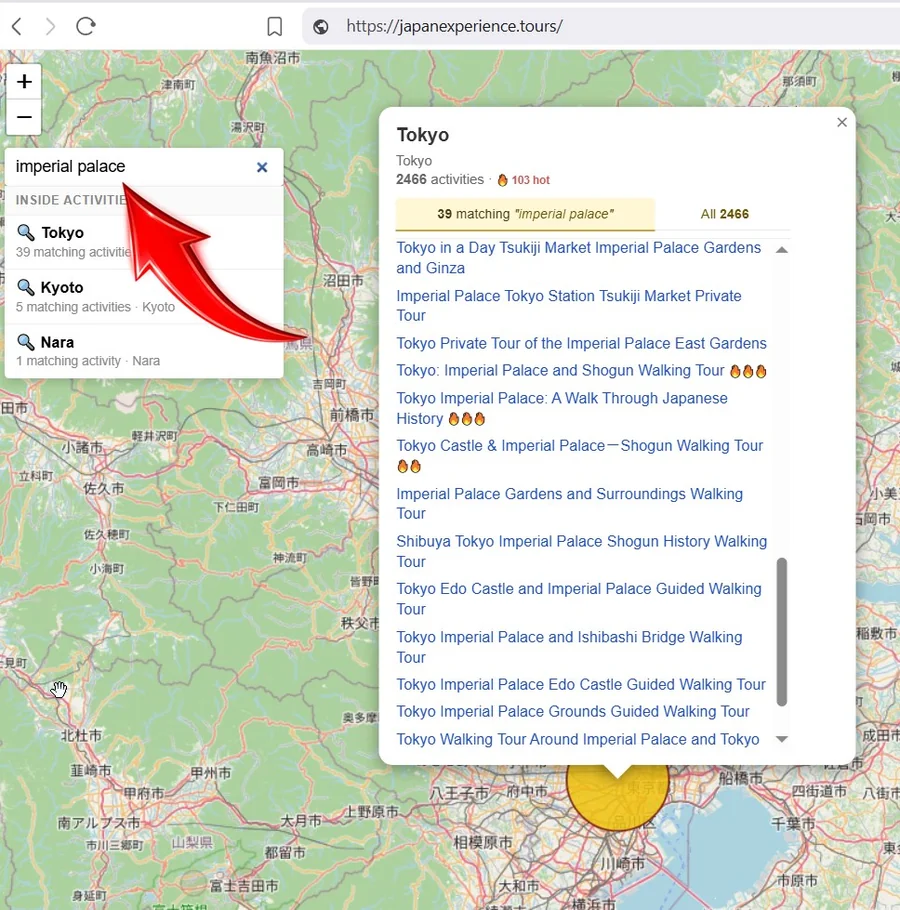
When do paid GetYourGuide tours add value over the free options?
The free 60-minute Imperial Household Agency tour is excellent at one thing: walking you through the Inner Palace Grounds along a fixed 2.2-kilometre route while an English audio guide narrates the architectural and ceremonial highlights. It is light on storytelling, light on context, and entirely focused on what you can see from the official path. If that is what you want, book it and skip everything else.
Paid GetYourGuide tours generally do something different. They start outside the Imperial Palace fence and treat the palace as one anchor in a wider Marunouchi historical walk. A typical itinerary covers the outer moat, Nijubashi, Wadakura Fountain Park, the East Gardens, and then continues outward to nearby districts: a one-block walk to Marunouchi’s Meiji-era brick architecture, a longer route down to Tsukiji’s outer market, or a Ginza segment with shogun-era trading-house history. The guide is live and bilingual, takes questions, sets pace to your group, and weaves Edo Castle history (the Tokugawa shogunate seat from 1603 to 1867), Meiji Restoration context (the 1868 capital and imperial residence move from Kyoto to Tokyo), and Showa-era reconstruction narrative (the palace burned in the 25 May 1945 air raid, the current 1968 Kyuden by Junzo Yoshimura) into the walk.
The honest comparison: the free tour gets you closer to the palace and is unbeatable on price. A paid tour gets you better narrative density and combines the palace with adjacent neighbourhoods you would otherwise navigate alone. If you have done extensive reading, the free tour is enough. If you want the Edo-to-Reiwa story told in real time and pointed at the actual buildings, the paid format is what to book. Many travellers do both, on separate days.
A brief history: from Edo Castle to imperial residence
The grounds you walk today were Edo Castle, the seat of the Tokugawa shogunate from 1603 to 1867 and at its peak the largest fortress in the world by enclosed area. The keep that once stood on the Tenshudai foundation was completed in 1638 and burned in the Great Fire of Meireki in 1657; the shogunate, prioritising urban reconstruction over symbolism, never rebuilt it. The Honmaru and Ninomaru palaces continued in use until 1867, when the last shogun, Tokugawa Yoshinobu, surrendered Edo to imperial forces.
In 1868 the Meiji Emperor moved the imperial residence from Kyoto to the renamed Tokyo, occupying the former shogunal grounds. The first Western-influenced Meiji Palace was completed in 1888, and the iron-truss Nijubashi double-bridge that frames the most famous postcard view of the palace dates from the same year. That Meiji Palace stood for 57 years until American B-29 bombers destroyed it in the 25 May 1945 firebombing of Tokyo, the same raid that killed an estimated 7,000 civilians across the central wards.
The current Kyuden complex was designed by Japanese modernist architect Junzo Yoshimura and completed in 1968, opening for use in April 1969. The buildings are steel-framed reinforced concrete in modernist proportions but use clearly Japanese architectural references: large gabled hipped roofs, exposed timber-style columns and beams, and pavilions raised on stilts in homage to Shinto shrine geometry. Yoshimura, who resigned partway through the project in 1965 over scope disputes with the Imperial Household Agency, framed his ambition as building “a new palace for Japan so elevated in grace and dignity that it will be worthy of being preserved for posterity.” The Nijubashi survives. The keep does not. What you see today is layered: Edo bones, Meiji bridges, Showa palace, and a city that built itself around all three.
Sources
- Imperial Household Agency — Visit Guidelines for Imperial Palace tour — official source for tour times, capacity (200 advance + 300 same-day), 2.2 km route description, closed days
- Imperial Household Agency — East Gardens of the Imperial Palace — official seasonal hours and closed days for the East Gardens
- Imperial Household Agency — Application for Visit — online reservation flow up to 30 days ahead
- Imperial Household Agency — Visit of the General Public for the Emperor’s Birthday — official 23 February 2026 schedule, balcony appearance times, gate logistics
- Imperial Household Agency — Visit of the General Public for the New Year Greeting — official 2 January 2026 schedule and entry/exit gates
- Japan National Tourism Organization — Imperial Palace — JNTO overview and access summary
- Tokyo Convention & Visitors Bureau (Go Tokyo) — Imperial Palace Guide — Tokyo tourism bureau visitor guide
- The Japan Times — Imperial Palace street opened to public for spring season (2026) — confirmed Inui-dori 2026 spring opening dates
- Wikipedia — Tokyo Imperial Palace — historical timeline (1603–1867 shogunate, 1888 Meiji Palace, 1945 air raid, 1968 Kyuden), 115-hectare ground area, 21-hectare East Gardens, architect Junzo Yoshimura
- Wikipedia — Edo Castle — Edo Castle history, Tenshudai foundation, Great Fire of Meireki 1657
- TIME archive — The Emperor’s New Palace — primary source for the Yoshimura quote on design ambition
- japan-guide.com — Tokyo Imperial Palace — independent travel guide reference for tour details and Nijubashi history
- MATCHA — Imperial Palace Run route guide — running route etiquette, counterclockwise convention, runner-station options